The Price of Power: State AGs Clash Over Soaring Energy Costs, Green Jobs, and Toxic Toll
Authors
Share
State AGs Take Sides In America’s Energy War
Skyrocketing electricity bills are hammering American households. Energy prices already outpace overall inflation and are expected to climb even further––with some regions bracing for surges as high as 30%. As public frustration mounts and voters demand answers, politicians remain sharply divided on the best path forward.
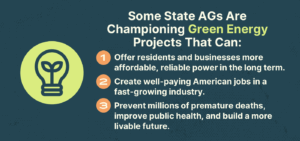
State attorneys general (state AGs) are picking sides in the ongoing conflict over America’s energy future. Some are championing clean energy policies and projects that are better for people and the planet––while offering cheaper, more reliable power in the long run and creating well-paying jobs in one of the fastest-growing industries in 2024.
These state AGs have filed numerous lawsuits against the Trump administration for impeding vital renewable energy initiatives that hurt American wallets, jobs, health, and the environment. They’ve also urged Congress to preserve landmark clean energy provisions.
Meanwhile, other state AGs have penned official letters praising the current administration’s misguided efforts to prop up the fossil fuel industry at voters’ expense. Some have even publicly dismissed the “green agenda” as foolish, promoting fossil fuels as the only reliable and affordable option.
By advocating for radically different energy paths, these opposing state AG coalitions are shaping the very policies that will power communities nationwide––bringing either real relief or greater hardship.
Why Green Energy Makes Sense
With all the noise around green energy, it can be hard to separate fact from fiction. Here are five key takeaways:
- Green Energy Is Cheaper. More than 90% of new renewable energy projects now cost less than fossil fuel alternatives. A 2023 Columbia Business School study also confirms that switching to renewables can cut electricity bills for everyday consumers.
- Green Power Makes The Energy System More Reliable. While fossil fuels are finite resources that will eventually run out, renewable energy is effectively limitless and has become increasingly reliable due to advances in battery storage. Developing green energy also strengthens the power grid, reducing vulnerability to outages, supply disruptions, and other interruptions.
- Green Energy Drives Job And Economic Growth. In 2024, clean energy jobs grew over three times faster than the overall labor market, even as oil and gas employment continued to fall despite record production. The Clean Jobs, Better Jobs report also found that, in 2019, clean energy workers earned 25% more than the national median and were more likely to have health and retirement benefits.
- Green Fuel Cuts Toxic Air Pollution. Fossil fuel pollution is deadly. Harvard estimates more than 8 million related deaths in 2018 alone. Reducing fossil fuel reliance could cut air-pollution deaths by about 61%, according to a 2023 modelling study. Fossil fuel pollution is also linked to serious health problems, from asthma and heart disease to cancer and depression––with low-income populations, ethnic minorities, and marginalized communities disproportionately burdened.
- Green Power Offers a More Livable Future. Climate anxiety—feelings of fear, anger, grief, guilt, despair and powerlessness over worsening climate-related tragedies and looming threats––is on the rise. Terrified for their futures, many young people are experiencing panic attacks, sleepless nights, and obsessive thinking. A 2024 Lancet study even found that more than half of 16- to 25-year-olds are reluctant to have children because of climate change fears, more evidence that climate anxiety is hitting an existential nerve in younger generations. Expanding green energy offers hope and tangible progress toward a more promising, livable future.
The bottom line? Supporting clean energy policies just make sense. Green energy benefits people, planet, and the U.S. economy.
Americans Want More, Not Less Renewable Energy
The U.S. still relies heavily on nonrenewable energy resources like oil and natural gas to power homes, businesses, and communities across the country. Yet some of the largest fossil fuel companies have known for decades that continued reliance on their products would drive potentially catastrophic climate change.
Instead of supporting the crucial shift to cleaner, greener, renewable energy, the fossil fuel industry has generally worked to block progress. Public opinion, however, has proven wiser than many elected officials.
Even after misinformation campaigns, billions spent on fossil fuel advertising, and the second Trump administration, most Americans still want more renewable energy development. A 2025 Pew Research Center survey found that 60% of U.S. adults prioritize expanding wind and solar over oil, coal, and natural gas.
Renewable Energy Is Smart
The urgent need for renewable energy development is impossible to overlook. From more frequent, intense hurricanes to longer, destructive fire seasons, the alarming effects of a warming planet are being felt from coast to coast.
But as state AGs who support green power often argue, embracing clean energy isn’t just essential to curbing fossil fuel damage––it’s smart policy, too.
For communities struggling with soaring energy bills, low wages, toxic air pollution, and climate-related stress, large-scale renewable energy investments can be transformative on many levels.
State AGs Split On Clean Energy Transition
Here are six key ways state AGs have exercised their power to either support the clean energy transition or double down on dirty fossil fuels:
1. Safeguarding Groundbreaking Clean Energy Incentives.
Background: The Inflation Reduction Act (IRA) of 2022 is a landmark legislation representing the “single largest investment in climate and energy in American history.” The act establishes tax credits, grant programs, and other incentives designed to spur large-scale investment in clean energy nationwide. According to Climate Power, members of Congress have already attempted to repeal the IRA’s climate and clean energy plan along with other provisions more than 50 times.
State AG Action: On January 16, 2025, a coalition of 17 AGS, led by Massachusetts AG Andrea Joy Campbell sent a letter urging Congress to preserve the IRA in order to continue making progress on its crucial goals. The AGs highlighted the impressive benefits of the IRA, writing:
“As a result of the IRA, our nation is strengthening domestic energy security, reducing energy costs, diversifying our domestic energy resources, rebuilding our domestic manufacturing economy, bolstering and modernizing critical infrastructure, and creating well-paying jobs while simultaneously reducing harmful pollution.”
Significance: Rolling back the IRA would put energy costs, clean energy investment, and thousands of jobs at risk. By writing to Congress, the AGs are stepping in to defend Americans’ clean energy progress and advance a greener, healthier, more secure energy system.
2. Keeping America’s Wind Power on Track.
Background: In January 2025, President Trump issued a memorandum directing federal agencies to pause new and renewed approvals for wind-energy projects—stalling leasing and permitting applications nationwide. His administration later halted construction of Revolution Wind, a nearly complete multi-state offshore wind project set to power more than 350,000 homes, citing only unspecified references to “national security” concerns.
State AG Action: On May 5, 2025, a coalition of 18 AGs, led by New York AG Letitia James, sued to end the nationwide freeze on wind-energy reviews. Litigation in that case remains ongoing. Connecticut AG William Tong and Rhode Island AG Peter Neronha also filed another lawsuit challenging the Revolution Wind stop-work order as arbitrary and unlawful. Revolution Wind filed its own case, and in September 2025, a district court granted the company a preliminary injunction allowing construction to resume.
Significance: Delaying wind energy development prevents states from meeting increased public demand for reliable, affordable electricity, while achieving their climate goals and reducing harm to public health and the environment. It also threatens thousands of existing and anticipated clean energy jobs across the country. Revolution Wind alone supports over 2,000 jobs and is projected to deliver hundreds of millions in energy savings to Connecticut and Rhode Island households over 20 years. By suing to stop the executive branch from hindering wind power, these state AGs are leveraging their authority to protect clean, affordable energy production and thousands of jobs from political interference.
3. Defending Solar Energy Savings for Low-Income Communities.
Background: In 2023, the Biden administration launched Solar for All, a $7 billion IRA-funded program aimed at improving energy affordability and pollution. The Environmental Protection Agency (EPA) awards competitive grants to states and other entities expanding residential solar energy in low-income and disadvantaged communities. On his first day back in office, President Trump issued an executive order directing federal agencies to immediately pause all IRA funds and review the programs they support. Months later, the EPA terminated Solar for All, blocking access to most of the grants already awarded.
State AG Action: On October 16, 2025, a coalition of 20 AGs, led by Arizona AG Kris Mayes, Minnesota AG Keith Ellison, and Washington AG Nick Brown, sued the EPA for clawing back grants already awarded under Solar for All.
Significance: Solar for All was designed to bring energy savings to over 900,000 households, support thousands of clean-energy jobs, and curb air pollution. The AGs’ lawsuit seeks to restore these benefits and protect families in low-income and disadvantaged areas from steep energy bill increases.
4. Fighting To Preserve Billions for National Green Banks.
Background: As part of the IRA, Congress established the Greenhouse Gas Reduction Fund (GGRF), a $27 billion program designed to cut greenhouse gas emissions and accelerate the clean energy transition. In 2024, the EPA awarded $14 billion in GGRF grants to green banks––organizations that leverage public funds and private capital to drive clean energy projects. Earlier this year, the agency terminated the grants, citing fraud concerns, but a judge called those assertions “vague and unsubstantiated.”
State AG Action: On March 19, 2025, four AGs—led by Minnesota’s Keith Ellison and California’s Rob Bonta—took the EPA and Citibank to court over the frozen GGRF grants. The AGs argue the agency had no legal basis to terminate the awards and that Citibank, which holds the funds on the EPA’s behalf, unlawfully failed to release the money to their states’ public green banks as required by law.
Significance: The AGs’ lawsuit exposes how the frozen GGRF funds threaten to derail crucial clean-energy investments across the country and undermine confidence in the nation’s emerging green financing system. Their complaint notes that, in Maine alone, one green bank projected it would run out of capital within a year—leaving more households without funding for energy-efficiency upgrades like heat pumps, which can save more than $700 annually on heating bills.
5. Endorsing the Administration’s Toxic Energy Agenda.
Background: Since returning to office, President Trump has rolled back limits on coal pollution, opened more federal land to coal mining, and allocated new funding to keep coal-fired power plants running longer.
State AG Action: In March 2025, a coalition of 23 AGs, led by West Virginia AG JB McCuskey, Wyoming AG Bridget Hill, and North Dakota AG Drew Wrigley, sent a letter to the Interior Secretary stating:
“We support the Trump Administration’s efforts to undo irrational, liberal energy policy to bring all of our coal-fired power plants back on-line[.]”
Significance: By labeling clean energy policies “irrational” and applauding the executive branch’s push to revive dirty fossil fuels, the AGs’ letter reinforces misguided narratives that undermine America’s shift toward a greener, smarter, and more affordable energy future.
6. Promoting Dirty Fossil Fuels Over Green Energy.
Background: In July 2025, Kentucky AG Russell Coleman reached a proposed settlement with energy companies to build two new natural gas plants and keep two coal plants running longer.
State AG Action: In his official public announcement, AG Coleman stated:
“In sharp contrast to the nonsensical green agenda of the Biden Administration, this agreement reinvests in affordable and reliable fossil fuel energy to power Kentucky’s future.”
Significance: AG Coleman’s statement justifies support for fossil fuel expansion by framing green energy as impractical, suggesting renewable energy cannot provide affordable, reliable power. By promoting a false trade-off, it empowers political forces aiming to prolong reliance on dirty fossil fuels.
Shaping America’s Energy Future
State AGs are at odds in the pivotal struggle over U.S. energy. Some wield their bully pulpit to insist that reliable, affordable energy depends on protecting fossil fuels––one of the dirtiest, most powerful industries in the world.
Others defend clean energy policies and projects that reflect what most voters want: a greener, healthier future that benefits the economy by delivering more affordable, reliable power and well-paying jobs.
Today’s state AGs are shaping the nation’s energy path––influencing how much Americans and the rest of the planet will pay for power.
The Leadership Center for Attorney General Studies is a non-partisan organization dedicated to educating the public about the important role state attorneys general play in addressing pressing issues, enforcing laws, and bringing about change.