This State AG Victory Could Save You Thousands: Beating Back Costly, Unlawful Tariffs in Court
Authors
Share
Important Legal Update: The Supreme Court has now affirmed this victory, striking down the unlawful tariffs at issue that put undue strain on American families, threatened small businesses and jobs, and undermined the constitutional safeguards of our democracy.
On February 20, 2026, the U.S. Supreme Court delivered a decisive ruling that cemented the legal victory analyzed below. The Court sided with a coalition of state attorneys general (state AGs), striking down the president’s unlawful tariffs—a sweeping win for hard-working Americans, small businesses, and the rule of law.
In the wake of this triumph, several AGs highlighted why the ruling matters to everyday Americans, from the costs they face at home to the constitutional checks that keep government accountable.
Oregon AG Dan Rayfield, who led the multistate coalition before the Supreme Court, emphasized the Court’s clear rejection of executive overreach and the urgent need to protect American families from unlawful price hikes amid a persistent affordability crisis:
Today, the Supreme Court made it clear that no President gets to levy taxes on Americans disguised as tariffs. At a time when we should all be working together to do everything in our power to keep the cost of living down for working families, the President tried to sidestep Congress to increase prices on groceries, utilities, and basic everyday necessities.
California AG Rob Bonta, who filed a separate lawsuit challenging the unlawful tariffs, cautioned that the enormous harm already inflicted cannot be overlooked:
While this is great news, we must not forget the chaos that sent businesses, consumers, and global economies reeling.
Connecticut AG William Tong demanded real-world accountability for the families and businesses harmed by the unlawful tariffs:
We’ve all been paying out of pocket for this lawless and irrational tariff war. Connecticut and ten other states stood up to the President and sued. We won in the Court of International Trade. We won in the Court of Appeals. We’ve won now in the Supreme Court. Mr. President, what’s your plan now to give us our money back?
Colorado AG Phil Weiser underscored the separation-of-powers principle at the heart of the case:
We cannot have national trade policy decided on a whim, without any justification, and in defiance of the law. Under the Constitution, only Congress has the power to tax and impose tariffs […] if Congress fails to act and do its job, we’ll be back in court.
Arizona AG Kris Mayes reminded the public that American democracy itself was at issue in this case, not just trade or economic policy:
The rule of law is worth fighting for. American democracy is worth fighting for. Today, we won one of those fights.
While the Court’s ruling definitively ends this unlawful tariff regime, President Trump has already announced plans to impose a 15 percent global tariff under a separate statute that requires him to obtain Congress’s approval to extend beyond 150 days.
Much remains uncertain, but amid ongoing economic strain, the state AGs who challenged these illegal tariffs are standing guard––ready to defend everyday Americans from harmful, costly policies that violate the rule of law.
State AGs Fight Back Against Costly, Unfair Taxes
From unaffordable housing to crushing medical debt, Americans naturally have money on their minds. Now most are worried about unlawful, sweeping tariffs––taxes on foreign goods that importers typically pass on to consumers.
These tariffs have rattled the economy, pushed small businesses to the brink, and are expected to drive up the cost of living even further, piling on more financial stress. In August, Goldman Sachs’ chief economist warned that consumers have already shouldered an estimated 22% of tariff costs through June and are on track to carry a whopping 67% by October.
So who’s looking out for your hard-earned cash? A group of state AGs just scored a major win on your behalf, convincing the U.S. Court of Appeals to rule that most of these new tariffs are unlawful. Their efforts demonstrate that state AGs can step in to keep the federal government in check and push back against costly, unfair taxes that make life harder for everyday people.
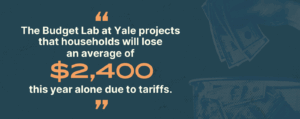
The Largest Backdoor Tax Hike Coming For You
Over the course of his second term, President Trump has issued executive orders implementing broad, wide-ranging, ever-shifting tariffs on imported goods from over 60 countries, including those we rely on most to meet our global trading needs.
Based on current legal rulings, Congress never authorized or approved most of these far-reaching tariffs. That means they were effectively imposed without your vote, even though taxation without representation undercuts one of the nation’s bedrock principles.
On top of that, these undemocratic tariffs carry steep real-world consequences for the average U.S. consumer––who needs more financial relief and protection, not additional hardship.
As U.S. companies are forced to raise prices, downsize, or close their doors, most of us will feel the burden, but vulnerable low-income households will be hit hardest. This makes the President’s hidden, backdoor approach to these regressive taxes all the more troubling.
The State AG Coalition Defending Your Wallet
Standing in the way of these unlawful, oppressive tariffs is a group of 12 state AGs from different parts of the country. These top-ranking legal watchdogs just won a lawsuit in the federal court of appeals where they argued that the President lacks authority to unilaterally impose tariffs under the International Emergency Economic Powers Act (IEEPA). Their challenge aligns with a separate federal case filed by California AG Rob Bonta.
Together, they’re fighting to stop these unfair, indirect taxes from draining your wallet. Joining them is a coalition of small businesses who say that rising prices and supply chain disruptions will put them out of business. The court has allowed the tariffs to stay in place temporarily pending an appeal to the U.S. Supreme Court, which has fast-tracked the case for review.
As state AGs gear up for the next legal showdown over these tariffs, three urgent questions hang in the balance:
1. How Much More Will Tariffs Take From Your Paycheck? Many leading economists agree that Americans will have to pay far more for everyday goods as companies gradually pass on the costs of tariffs to consumers––a tactic now known as “sneakflation.”
In fact, major companies like Walmart, Costco, Best Buy, Target, Home Depot, and Nike have either had to raise prices or plan to do so in response to tariffs. Small businesses are also feeling pressured to mark up their products now that pre-tariff stored up inventory is starting to run out.
2. Will Your Job Or Business Survive? Not all businesses can afford to raise prices or have the leverage to effectively negotiate with foreign suppliers over increased tariff costs. Small businesses––and the 45.9% of Americans they employ––are particularly at risk.
Even a modest increase in tariffs can prove devastating for these companies, since they make up 97% of the nation’s importers and tend to operate on razor-thin margins. Some are on the verge of giving up. Others are trimming staff, slowing hiring, and considering layoffs.
But it’s not just small mom-and-pop shops struggling to survive the unparalleled chaos and uncertainty unleashed by the Trump administration’s trade policies. Howard Miller, a Midwest-based manufacturer of handcrafted clocks and home furniture with nearly 200 workers across state lines, opted to shut down after tariffs pushed its third-generation, family-owned business over the edge.
A 2021 Oxford Economics study estimated that Trump’s first term tariffs cost Americans 245,000 jobs and cut household purchasing power by $675. The Center for American Progress’ recent analysis on manufacturing employment also paints a grim picture, showing a sharp downward trend since April when tariffs roiled the stock market and fueled recession fears.
Does this mean all tariffs are bad? Not necessarily. Some economists explain that targeted tariffs can help support American workers, but only as part of a smart, broader plan that has clear, precise goals and includes strategic investments, industrial incentives, and vital union protections. In this case, not only has the President implemented wildly erratic, across-the-board tariffs, but his administration has also sought to roll back crucial union rights and Biden-era subsidies for semiconductor and clean energy manufacturing.
3. Will Your Vote Matter As Much As Before? The U.S. was founded in direct opposition to unreasonable, unchecked power. Giving a single chief executive, who also commands the military, control over the purse strings dangerously elevates the risk of tyranny.
That’s why our founders entrusted Congress––not the president––with the power of taxation. Through their elected representatives, citizens have a voice in deciding which taxes are fair and how they affect their lives. Yet the President now claims he has the power to unilaterally impose tariffs that disrupt global trade and siphon wealth away from poor and working–class Americans into the hands of the rich.
As costly, unlawful tariffs threaten to overwhelm struggling households, destroy small businesses, and erode the fundamental checks and balances that safeguard our democracy, some state AGs are pushing back. Their recent victory shines a light on the kind of real public leadership everyday Americans truly need.
The Leadership Center for Attorney General Studies is a non-partisan organization dedicated to educating the public about the important role state attorneys general play in addressing pressing issues, enforcing laws, and bringing about change.